Computational methods
Orders of magnitude more of the design space covered in a fraction of the time, while retaining the full physics of the underlying solver throughout.
Coarse-level sweeps
A cheap first pass across every condition you care about on the coarsest mesh, so the expensive solves go where they matter.
Adjoint design optimization
Adjoints make optimization cost independent of the number of design variables.
Design gradients, not guess-and-rerun.
- 7FEA, CFD and FSI/TFSI adjoint frameworks
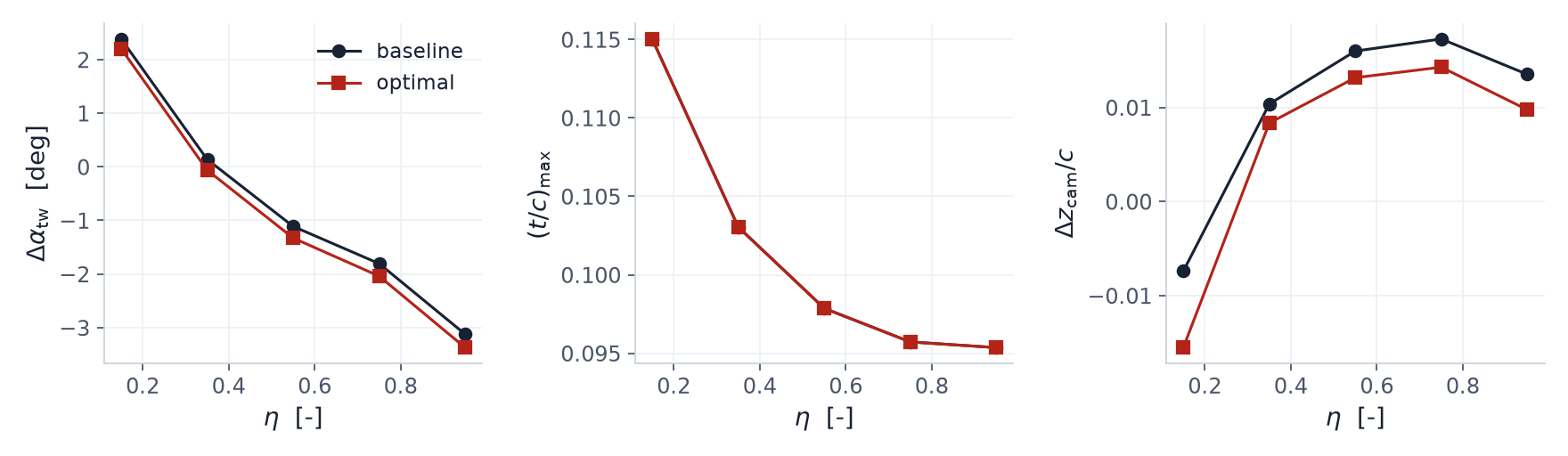
Optimizing a shape today means changing it, re-running the simulation, comparing, and repeating. Expending time and resources to brute-force over a handful of variants. Certonomous computes design gradients instead: the geometry moves straight to the optimum for your constraints, not the best of a handful you sampled. You save time and compute because you don’t need to run an arbitrary number of simulations.
Reduced-order uncertainty quantification
Physics-based reduced-order models replace brute-force Monte Carlo for uncertainty.
Orders of magnitude fewer runs. Backed by theoretical guarantees.
Conventional uncertainty quantification: Monte Carlo, re-running the full simulation hundreds of times. Our built-in reduced-order modeling framework gets you the same calibrated ranges from a fraction of the runs. UQ becomes an everyday tool, not an ad hoc ordeal.
Ranges in, ranges out.
Real inputs are ranges: a tolerance band, an operating envelope, a material spec that varies. Certonomous models three kinds of uncertainty natively, so results arrive as calibrated ranges instead of false precision.
- Parametric
- Uncertainty in the inputs: material properties, boundary conditions, coefficients. Propagated through a fast reduced-order framework. A range of inputs maps to a range of outputs.
- Epistemic
- Uncertainty from modeling choices: turbulence models, numerical approximations, model assumptions.
- AgenticThe lab's self-awareness
- The lab's own confidence. On a familiar case it acts decisively; on one it has never seen it still solves end to end, flags the unfamiliarity, and watches the run closely.
Under the hood
Parametric, epistemic and agentic UQ in the core, not a post-hoc study.
Orders of magnitude more of the design space covered in a fraction of the time, while retaining the full physics of the underlying solver throughout.